

Become a foster parent
3 facts about children in care:
- The numbers are growing official figures show that in 31st March 2019 there were 78,150 children in care in England, that’s a rise of 28% in a decade. Numbers have grown from 75,370 in 2018 and almost 20,000 more than in 2009 when 60,900 children were looked after.
- Over-10s account for 63% of all young people in care, with teenagers six times more likely than younger children to be living in residential or secure children’s homes, which have poorer outcomes.
- We need more foster parents there is a lack of places to house vulnerable children in the UK.
Definition and a little history
A definition from the NSPCC a child who has been in the care of their local authority for more than 24 hours is known as a looked after child. Looked after children are also often referred to as children in care.
The care system was created under the old Victorian Poor Laws. It was deemed morally bad if you were pregnant without a husband and in turn, the children were also deemed less. The Poor Laws also swept up many who were trapped in poverty, putting them in workhouses. Times have changed and whilst being illegitimate will not be the primary reason for being in care, it remains a stigmatising state intervention. Whilst being there for the protection and safety of vulnerable children, my own experience of being in care from the age of 12, and that of countless others, is not always to be desired.
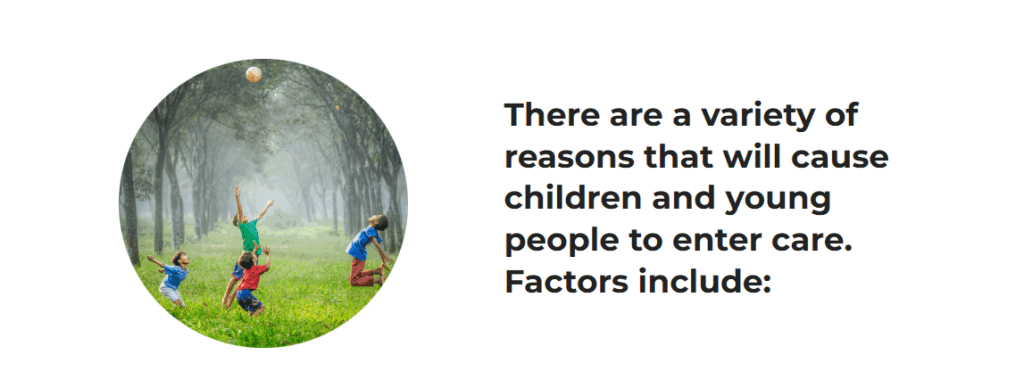
- Social services may have intervened if there is an assessment that the child was at significant risk of harm. Where this occurs the child is usually the subject of a court-made legal order
- There may have been an agreement with the child’s parents where, for example, the parents are unable through illness to look after their child or if their child has a complex disability
- The child could be an unaccompanied asylum seeker, with no responsible adult to care for them; there has been a significant increase in recent years. The Guardian recently reported that the UK has the third-highest number of unaccompanied child asylum seekers in Europe.
The placement options for looked after children are living with foster parents, living in a residential children’s home or are living in residential settings such as schools or secure units.
More must be done to ensure that all looked after children are healthy and safe during their time in care and can move successfully into adulthood. We need to see better outcomes for people who leave care and have been negatively affected.
In the UK, the Fostering Network is the leading fostering charity and runs an annual campaign called Foster Care Fortnightâ„¢ both to raise the profile of fostering and to show how foster care transforms lives. It certainly transformed mine and I feel very lucky. Thousands of new foster families are needed every year to care for children and according to the Fostering Network, the greatest need is for foster carers for older children, sibling groups, disabled children and unaccompanied asylum-seeking children. If we cannot find stable and loving homes for vulnerable children, society pays the price.
Crime Care leavers are hugely overrepresented in the prison population and are more likely to have a criminal conviction. Government figures estimate that care leavers represent between 24% and 27% of the adult prison population. Yet the numbers of young people entering care represent less than 1% of under 18s in the population.
Mental health Inevitably, because of their lived experiences, looked after children are highly vulnerable to emotional and relationship difficulties. Research consistently shows that the mental health of looked after children is poorer than that of the general population. There is a far higher prevalence of mental health and behavioural disorders, difficulties and problems in looked after children and this carries into adulthood.
But it’s not all bad news. Let’s also celebrate those who have succeeded despite the challenges of being in the care system. Lemn Sissay MBE is a renowned English poet, author and broadcaster. I was recently inspired by listening to his story on a podcast which you can listen to here and of course, there are many other success stories.
You find yourself on this website because you are interested in progression, development and the realisation of dreams; coaching is a tool to support that. As we work on ourselves we can also think about how we share our talents, our gifts. We face unprecedented challenges but also opportunities to make the future different, both for ourselves and for others. Do something extraordinary; change the outcome for a young person.